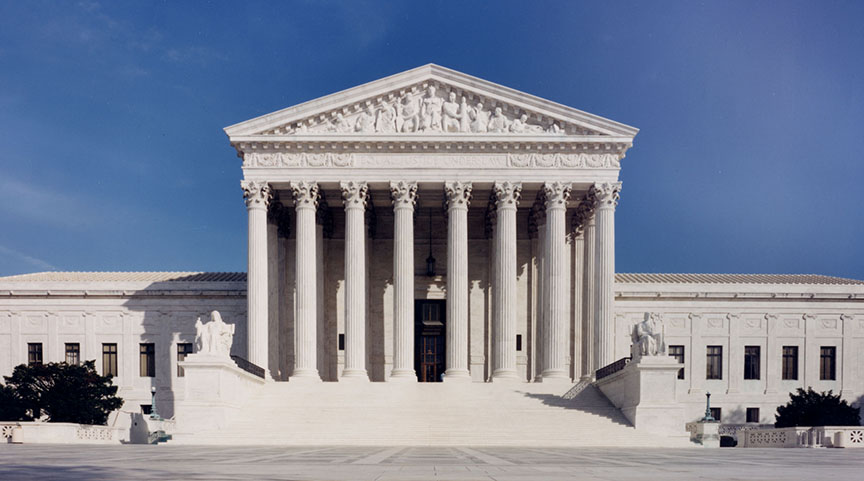
 The Judiciary
Supreme Court
Decisions, in the Court’s own words.
The nine justices
Who sits on the Court now, who nominated them and when they joined. Open a card to read the Court’s own full biography.

Chief Justice of the United States
John G. Roberts, Jr.
Nominated by George W. Bush · joined 2005
In plain words: Leads the Court as Chief Justice. Before joining, he was a federal appeals judge in Washington, D.C.
Official biography
John G. Roberts, Jr., Chief Justice of the United States, was born in Buffalo, New York, January 27, 1955. He married Jane Sullivan in 1996 and they have two children - Josephine and Jack. He received an A.B. from Harvard College in 1976 and a J.D. from Harvard Law School in 1979. He served as a law clerk for Judge Henry J. Friendly of the United States Court of Appeals for the Second Circuit from 1979–1980, and as a law clerk for then-Associate Justice William H. Rehnquist of the Supreme Court of the United States during the 1980 Term. He served as a Special Assistant to the Attorney General of the United States from 1981–1982, Associate Counsel to President Ronald Reagan, White House Counsel’s Office from 1982–1986, and as Principal Deputy Solicitor General from 1989–1993. From 1986–1989 and 1993–2003, he practiced law in Washington, D.C. He served as a Judge on the Court of Appeals for the District of Columbia Circuit from 2003–2005. Nominated as Chief Justice of the United States by President George W. Bush, he assumed that office on September 29, 2005.

Associate Justice
Clarence Thomas
Nominated by George H. W. Bush · joined 1991
In plain words: The longest-serving current justice. He previously led the federal equal-employment agency and was a federal appeals judge.
Official biography
Clarence Thomas, Associate Justice, was born in the Pinpoint community near Savannah, Georgia on June 23, 1948. He attended Conception Seminary from 1967-1968 and received an A.B., cum laude, from College of the Holy Cross in 1971 and a J.D. from Yale Law School in 1974. He was admitted to law practice in Missouri in 1974, and served as an Assistant Attorney General of Missouri, 1974-1977; an attorney with the Monsanto Company, 1977-1979; and Legislative Assistant to Senator John Danforth, 1979-1981. From 1981–1982 he served as Assistant Secretary for Civil Rights, U.S. Department of Education, and as Chairman of the U.S. Equal Employment Opportunity Commission, 1982-1990. From 1990–1991, he served as a Judge on the United States Court of Appeals for the District of Columbia Circuit. President Bush nominated him as an Associate Justice of the Supreme Court and he took his seat October 23, 1991. He married Virginia Lamp on May 30, 1987 and has one child, Jamal Adeen by a previous marriage.

Associate Justice
Samuel A. Alito, Jr.
Nominated by George W. Bush · joined 2006
In plain words: Was a federal prosecutor in New Jersey and then a federal appeals judge for 15 years.
Official biography
Samuel A. Alito, Jr., Associate Justice, was born in Trenton, New Jersey, on April 1, 1950. He married Martha-Ann Bomgardner in 1985, and has two children - Philip and Laura. He served as a law clerk for Leonard I. Garth of the United States Court of Appeals for the Third Circuit from 1976–1977. He served as an Assistant U.S. Attorney, District of New Jersey, 1977–1981, as Assistant to the Solicitor General, U.S. Department of Justice, 1981–1985, as Deputy Assistant Attorney General, U.S. Department of Justice, 1985–1987, and as U.S. Attorney, District of New Jersey, 1987–1990. He was appointed to the United States Court of Appeals for the Third Circuit in 1990. President George W. Bush nominated him as an Associate Justice of the Supreme Court, and he took his seat January 31, 2006.

Associate Justice
Sonia Sotomayor
Nominated by Barack Obama · joined 2009
In plain words: Was a prosecutor in New York, then a federal trial judge and a federal appeals judge.
Official biography
Sonia Sotomayor, Associate Justice, was born in Bronx, New York, on June 25, 1954. She earned a B.A. in 1976 from Princeton University, graduating summa cum laude and a member of Phi Beta Kappa and receiving the Pyne Prize, the highest academic honor Princeton awards to an undergraduate. In 1979, she earned a J.D. from Yale Law School where she served as an editor of the Yale Law Journal. She served as Assistant District Attorney in the New York County District Attorney’s Office from 1979–1984. She then litigated international commercial matters in New York City at Pavia & Harcourt, where she served as an associate and then partner from 1984–1992. In 1991, President George H.W. Bush nominated her to the U.S. District Court, Southern District of New York, and she served in that role from 1992–1998. In 1997, she was nominated by President Bill Clinton to the U.S. Court of Appeals for the Second Circuit where she served from 1998–2009. President Barack Obama nominated her as an Associate Justice of the Supreme Court on May 26, 2009, and she assumed this role August 8, 2009.

Associate Justice
Elena Kagan
Nominated by Barack Obama · joined 2010
In plain words: Was dean of Harvard Law School and the U.S. Solicitor General, the government's top lawyer before the Court.
Official biography
Elena Kagan, Associate Justice, was born in New York, New York, on April 28, 1960. She received an A.B. from Princeton in 1981, an M. Phil. from Oxford in 1983, and a J.D. from Harvard Law School in 1986. She clerked for Judge Abner Mikva of the U.S. Court of Appeals for the D.C. Circuit from 1986-1987 and for Justice Thurgood Marshall of the U.S. Supreme Court during the 1987 Term. After briefly practicing law at a Washington, D.C. law firm, she became a law professor, first at the University of Chicago Law School and later at Harvard Law School. She also served for four years in the Clinton Administration, as Associate Counsel to the President and then as Deputy Assistant to the President for Domestic Policy. Between 2003 and 2009, she served as the Dean of Harvard Law School. In 2009, President Obama nominated her as the Solicitor General of the United States. A year later, the President nominated her as an Associate Justice of the Supreme Court on May 10, 2010. She took her seat on August 7, 2010.

Associate Justice
Neil M. Gorsuch
Nominated by Donald J. Trump · joined 2017
In plain words: Was a federal appeals judge in the Tenth Circuit, which covers several Western states.
Official biography
Neil M. Gorsuch, Associate Justice, was born in Denver, Colorado, August 29, 1967. He received a B.A. from Columbia University, a J.D. from Harvard Law School, and a D.Phil. from Oxford University. He clerked for Judge David B. Sentelle, of the United States Court of Appeals for the District of Columbia Circuit, and for Justices Byron R. White and Anthony M. Kennedy, of the Supreme Court of the United States. He spent a decade in private practice before being appointed Principal Deputy Associate Attorney General at the U.S. Department of Justice. He has taught law at the University of Colorado and George Mason University and serves on the boards of the National Constitution Center and the Colonial Williamsburg Foundation. In 2006, he was appointed to the United States Court of Appeals for the Tenth Circuit, where he served until President Donald J. Trump nominated him as an Associate Justice of the Supreme Court. He took his seat on April 10, 2017.

Associate Justice
Brett M. Kavanaugh
Nominated by Donald J. Trump · joined 2018
In plain words: Worked in the White House and then served as a federal appeals judge in Washington, D.C.
Official biography
Brett M. Kavanaugh, Associate Justice, was born in Washington, D.C., on February 12, 1965. He married Ashley Estes in 2004, and they have two daughters - Margaret and Liza. He received a B.A. from Yale College in 1987 and a J.D. from Yale Law School in 1990. He served as a law clerk for Judge Walter Stapleton of the U.S. Court of Appeals for the Third Circuit from 1990-1991, for Judge Alex Kozinski of the U.S. Court of Appeals for the Ninth Circuit from 1991-1992, and for Justice Anthony M. Kennedy of the U.S. Supreme Court during the 1993 Term. In 1992-1993, he was an attorney in the Office of the Solicitor General of the United States. From 1994 to 1997 and for a period in 1998, he was Associate Counsel in the Office of Independent Counsel. He was a partner at a Washington, D.C., law firm from 1997 to 1998 and again from 1999 to 2001. From 2001 to 2003, he was Associate Counsel and then Senior Associate Counsel to President George W. Bush. From 2003 to 2006, he was Assistant to the President and Staff Secretary for President Bush. He was appointed a Judge of the United States Court of Appeals for the District of Columbia Circuit in 2006. President Donald J. Trump nominated him as an Associate Justice of the Supreme Court, and he took his seat on October 6, 2018.

Associate Justice
Amy Coney Barrett
Nominated by Donald J. Trump · joined 2020
In plain words: Was a law professor at Notre Dame and then a federal appeals judge in the Seventh Circuit.
Official biography
Amy Coney Barrett, Associate Justice, was born in New Orleans, Louisiana, on January 28, 1972. She married Jesse M. Barrett in 1999, and they have seven children. She received a B.A. from Rhodes College in 1994 and a J.D. from Notre Dame Law School in 1997.She served as a law clerk for Judge Laurence H. Silberman of the U.S. Court of Appeals for the D.C. Circuit from 1997 to 1998, and for Justice Antonin Scalia of the Supreme Court of the United States during the 1998 Term. After two years in private law practice in Washington, D.C., she became a law professor, joining the faculty of Notre Dame Law School in 2002. She was appointed a Judge of the United States Court of Appeals for the Seventh Circuit in 2017. President Donald J. Trump nominated her as an Associate Justice of the Supreme Court, and she took her seat on October 27, 2020.

Associate Justice
Ketanji Brown Jackson
Nominated by Joseph Biden · joined 2022
In plain words: Was a federal public defender, a member of the U.S. Sentencing Commission, a federal trial judge and an appeals judge.
Official biography
Ketanji Brown Jackson, Associate Justice, was born in Washington, D.C., on September 14, 1970. She married Patrick Jackson in 1996, and they have two daughters. She received an A.B., magna cum laude, from Harvard-Radcliffe College in 1992, and a J.D., cum laude, from Harvard Law School in 1996. She served as a law clerk for Judge Patti B. Saris of the U.S. District Court for the District of Massachusetts from 1996 to 1997, Judge Bruce M. Selya of the U.S. Court of Appeals for the First Circuit from 1997 to 1998, and Justice Stephen G. Breyer of the Supreme Court of the United States during the 1999 Term. After three years in private practice, she worked as an attorney at the U.S. Sentencing Commission from 2003 to 2005. From 2005 to 2007, she served as an assistant federal public defender in Washington, D.C., and from 2007 to 2010, she was in private practice. She served as a Vice Chair and Commissioner on the U.S. Sentencing Commission from 2010 to 2014. In 2012, President Barack Obama nominated her to the U.S. District Court for the District of Columbia, where she served from 2013 to 2021. She was appointed to the Defender Services Committee of the Judicial Conference of the United States in 2017, and the Supreme Court Fellows Commission in 2019. President Joseph Biden appointed her to the U.S. Court of Appeals for the District of Columbia Circuit in 2021 and then nominated her as an Associate Justice of the Supreme Court in 2022.
Tier 1 · Photos and biographies: Supreme Court of the United States ↗ · checked 2026-11-26
Powers & limits in brief: Supreme Court and lower courts · Kinds of federal cases · Cases starting at the Supreme Court
Powers & limits
Supreme Court and lower courts
The Constitution creates one Supreme Court. Congress can establish lower federal courts.
Official text · Article III, Section 1
The judicial Power of the United States, shall be vested in one supreme Court, and in such inferior Courts as the Congress may from time to time ordain and establish. The Judges, both of the supreme and inferior Courts, shall hold their Offices during good Behaviour, and shall, at stated Times, receive for their Services, a Compensation, which shall not be diminished during their Continuance in Office.Kinds of federal cases
Federal courts hear the kinds of cases listed in the Constitution, including cases about federal law and treaties.
Official text · Article III, Section 2
The judicial Power shall extend to all Cases, in Law and Equity, arising under this Constitution, the Laws of the United States, and Treaties made, or which shall be made, under their Authority;—to all Cases affecting Ambassadors, other public Ministers and Consuls;—to all Cases of admiralty and maritime Jurisdiction;—to Controversies to which the United States shall be a Party;—to Controversies between two or more States;— between a State and Citizens of another State ,—between Citizens of different States,—between Citizens of the same State claiming Lands under Grants of different States, and between a State, or the Citizens thereof, and foreign States, Citizens or Subjects.Cases starting at the Supreme Court
Some cases begin at the Supreme Court. In other listed cases, it reviews decisions through appeals, subject to rules Congress makes.
Official text · Article III, Section 2
In all Cases affecting Ambassadors, other public Ministers and Consuls, and those in which a State shall be Party, the supreme Court shall have original Jurisdiction. In all the other Cases before mentioned, the supreme Court shall have appellate Jurisdiction, both as to Law and Fact, with such Exceptions, and under such Regulations as the Congress shall make.Source: National Archives · Constitution transcript · checked 2026-11-26. Original text may be affected by later amendments. Editorial explanations, not legal advice.
In plain words: Per curiam means the opinion is issued in the Court’s name, rather than signed by one justice. It does not mean every justice agreed.
Court’s table definitions ↗- 2026-11-09No. 26A560Unsigned opinionMullin v. Friends of the Ruidosa Church
Court’s own description
The Government is entitled to a stay of the preliminary injunction halting border-barrier construction because it is exceedingly likely to establish that the District Court lacked jurisdiction under §102(c)(2)(A) of the Illegal Immigration Reform and Immigrant Responsibility Act of 1996 over respondents’ claim that the Secretary of Homeland Security’s waiver of statutory requirements violated the major-questions doctrine.
Official opinion PDF ↗ - 2026-10-14No. 26A476Unsigned opinionFCC v. Brown
Court’s own description
The Fourth Circuit’s mandamus order requiring the Federal Communications Commission to resolve an application for review within 48 hours of its entry is stayed because the order improperly interferes with the Commission’s discretion to determine the timing and procedures of its deliberative process.
Official opinion PDF ↗
Primary source: U.S. Supreme Court · Checked 2026-11-29 12:33 UTC. Photo: U.S. Supreme Court.
This printout contains the current page or reading part only. Source links and collection dates are retained; later updates may change the record.